
Diabetic Foot Assessment & Treatment
The podiatrists at our Woolloongabba clinic are experienced health professionals and experts in the assessment and treatment of diabetes related foot complications.
How does diabetes cause foot complications?
Diabetes presents a serious risk of limb loss and amputation due to two major foot complications:
- Peripheral Neuropathy (nerve damage leading to sensation loss or chronic pain)
- Peripheral Arterial Disease (PAD) (narrowed or blocked arteries reducing blood flow)
Even minor or seemingly trivial injuries can rapidly become serious and limb-threatening, making foot complications the leading cause of hospital admission worldwide for people with diabetes.
If a person with diabetes develops a foot infection, these can sometimes be very severe and affect deep tissues such as bones and joints. These infections can difficult to treat effectively, and may require a coordinated team of health professionals to help manage. There is established research that people with diabetes who are affected by a major amputation ultimately have markedly reduced long term survival, with worse outcomes than most serious cancers.
(Ref: Armstrong DG, et al. Five year mortality and direct costs of care for people with diabetic foot complications are comparable to cancer. J Foot Ankle Res. 2020 Mar 24;13(1):16.)

What happens during a diabetic foot assessment?
We routinely receive referrals from GP's and diabetes specialists (endocrinologists) to undertake a formal diabetic foot assessment. The purpose of this assessment is to identify any risk factors for foot complications. With this information we can work with you to reduce the chance of serious problems such as amputation.
As part of our assessment we will ask you questions about your:
- medical history
- diabetes duration and how well your blood glucose levels have been able to be controlled
- any history of previous foot ulcers, foot infections or surgical management
- footwear needs or choices
- work, exercise and lifestyle physical demands
- an symptoms of 'burning' pains or reduced sensation or numbness (suggestive or nerve damage), or leg or foot pain and cramping - especially with walking or exercise (which might indicate reduce a blocked leg artery)
Then we will usually move to an examination of your feet and legs. Firstly, we will look at things such as:
- skin integrity and condition (can help identify reduced blood flow)
- any associated skin disorders (eg tinea infections, eczema)
- presence of calluses or pressure areas, or any nail disorders (thickened, irregular or damaged toenails)
- Any active areas of skin ulceration
- any congenital or acquired foot deformities (such as bunions, hammertoes, and flat feet). This might point towards a rare Charcot joint condition.
- any muscle, ligament or tendon conditions (eg tight calves, or ankle instability)
Then, it will be essential to do specific testing for:
- peripheral neuropathy - testing pressure and vibration perception (usually with the use of sensory monofilaments, and our electronic Vibrasense neuropathy testing equipment), checking tendon reflexes, observation and gait analysis, balance and movement
- peripheral arterial disease (PAD) - assessing pulses, capillary refill times, and Doppler ultrasonography to examine pulse signal parameters and perfusion quality
Once your podiatrist is satisfied they have gathered enough information, then they can be in a position to advise you and your other treating health professions about:
- the presence or absence of peripheral neuropathy or PAD
- any active or inactive Charcot joints
- active ulcer/wound grading
- overall diabetic foot risk classification (low, medium, high)
- any additional testing or referral needs (eg referral for x-rays, or to a vascular surgeon)
- recommended podiatry management plan and follow-up appointments

Spreading infection (cellulitis) in the foot of a person with diabetes requiring urgent antibiotic management

Pressure callus under the big toe in a person with neuropathy

Hidden ulcer revealed following careful debridement and removal of the overlying callus tissue.
Ready to book your diabetic foot assessment?
Call our Woolloongabba clinic on 07 3391 3900
Or
Tips for Preventing Complications
Health professionals recommend everyone with diabetes to have an annual diabetic foot check-up.
Daily foot inspection, immediate consultation with a podiatrist or GP for suspected problems, and strictly managing blood glucose levels are crucial for prevention.
Never walk barefoot or attempt to treat simple issues like corns, calluses or ingrown toenails yourself, and always wear spacious, well-fitting footwear. Look out for areas of colour change affecting the foot, such as red or darkened skin.

Doppler arterial examination to assess the quality of blood flow to the foot.
Charcot Joints and Neuroarthropathy
A lrarer, but very destructive complication is Charcot neuroarthropathy (or Charcot joint). This condition involves the collapse of foot joints, often after a seemingly minor injury, causing severe deformity and instability.
Charcot joints can be very difficult to diagnose initially, and are sometimes mistaken for conditions like infection or gout. Undiagnosed Charcot joint conditions can result in a highly deformed foot with extreme risk of future ulceration or even amputation if left untreated.

A deformed 'rocker bottom' foot caused by Charcot joint disease, creating a neuropathic ulcer under the cuboid bone of the foot.
Neuropathic Foot Ulcers
Foot ulcers in diabetes arise from either nerve damage (neuropathic) or poor blood supply (ischaemic).
Neuropathic ulcers are typically painless wounds, often under the forefoot joints, caused by unremitting pressure and lack of sensation. These usually heal easily with effective pressure offloading (special footwear, orthotics, or casts) and regular surgical debridement to remove hard, non-viable tissue.

Neuropathic ulceration and second degree burns in a patient with diabetes after walking barefoot on hot concrete during summer
Typically, we will need to use surgical instruments to 'debride' or cut-away non-viable tissue, callusing and irregular tissue in and around the ulcer. This is essential in order to heal the wound, and usually needs to be done at regular intervals, often once of more a week. In the presence of neuropathy this is a painless procedure.
Ischaemic Ulcers and PAD
In contrast to neuropathic foot ulcers, ischaemic ulcers are caused by a reduced blood supply from arteries leading from the heart down to the foot, called peripheral arterial disease (PAD). If the foot does not receive adequate blood flow and oxygen, then the skin and soft tissues can break down into wounds, ulcers and gangrene.
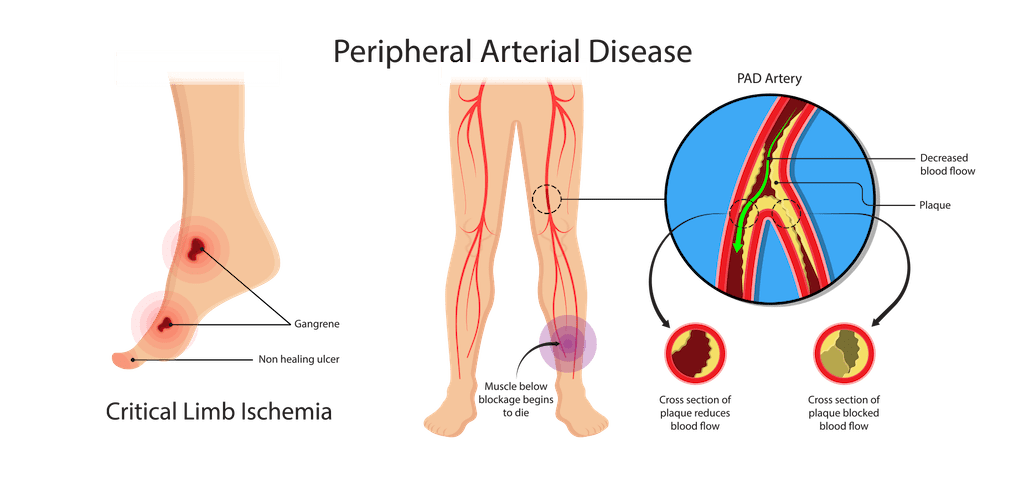
Ischaemic ulcers are very much harder to heal without restoring adequate blood flow. They will often require collaboration with procedures provided by vascular surgeon - such as a stent or bypass procedure.

Gangrene affecting the big toe in a patient with diabetes and peripheral arterial disease (PAD).
Frequently Asked Questions
Do I need an annual diabetic foot assessment?
Australian and international guidelines recommend at least an annual review to screen for foot complications from diabetes. If you do develop these secondary complications, then it may be necessary to see you more frequently.
What happens during a diabetic foot assessment?
Please see our description above on this page about the questions, examinations and tests we do during a diabetic foot assessment.
How often should someone with diabetes see a podiatrist?
Annual reviews are recommended, but some people need to see us quite regularly (sometimes every 6-8 weeks) to treat pressure calluses or nail disorders to prevent them causing ulcers of infections.
Acute ulcers or infections can require intensive management, and also a range of health professionals to help prevent more serious problems. In some circumstances, you may need to be admitted to hospital for specialised care such as intravenous antibiotics.
Can a podiatrist treat a diabetic foot ulcer?
Absolutely. However, not all podiatrists are necessarily experienced or confident with diabetes complications, ulcers and wound management. Our team have extensive experience in this area of practice.
Is a diabetic foot ulcer painful?
Neuropathic ulcers are almost always completely painless. By contrast ischaemic ulcers can often be very tender or uncomfortable.
What should I do if I notice a wound on my foot?
Please seek immediate attention from your podiatrist, GP or other health care professional. If you notice a new open wound, apply a suitable topical antiseptic like Betadine liquid, and use a simple cotton based dressing and secure it with medical tape until it can be reviewed by your treating practitioner.
Any redness should be assumed to be infection until proven otherwise and antibiotics may needed urgently.
What is a Charcot foot?
A Charcot foot is a condition in which one or more joints of the foot can develop painless swelling, deformity and collapse. More information is found further above on this page.
Can diabetic neuropathy affect my feet?
Yes, this is usually the first area to be affected. If it progresses, hands and other parts of the body can be affected as well. Please see our information above about the effects of peripheral neuropathy on the foot in people with diabetes.
Can a podiatrist check circulation in my feet?
Yes. We use a combination of physical examination and diagnostic equipment such as Doppler ultrasound to assess the quality of low through the arteries of the leg and into the foot. This will provide us with substantial information, but further tests such as a Duplex scan or angiogram done by a radiology clinic may be needed.
If there is a significant impairment in the quality of blood flow to the foot, we will likely recommend use see a vascular surgeon to see if you might benefit from surgery such as stenting to improve your blood flow.
Do I need a GP referral?
A GP referral is not required to see a podiatrist. However, if you wish to be covered for podiatry consultations under Medicare, then this will be necessary (although Medicare will only cover a small number of visits).
Can I claim podiatry through Medicare?
As mentioned above, a limited number of consultations may be available to claim through Medicare if you have a valid GP referral under a chronic disease/GP management plan. Ask your GP if you would like to be seen under these arrangements.
Where is your diabetic foot clinic in Brisbane?
Visit our Contact and Location page for how to find us at the Taylor Medical Centre in Woolloongabba.
Need help to take the next step? Here’s the summary.
If you are concerned about your feet and the effects that diabetes might be having on them, we are ready to lend a hand.
Our podiatry clinic is in Woolloongabba, opposite the Mater Hospital Rehabilitation Building, near the Brisbane CBD, and easily accessible by car, bus and rail.
Parking is available in our patient car park (fees apply) or in the surrounding streets. More info can be found here.
Additionally:
- you don't need a referral to see one of our podiatrists. Just call or book online to see one of our podiatry team
- if you wish to seek coverage under Medicare, a GP referral under a chronic disease management plan can allow a rebate to be claimed for a consultation with us
- most private health insurance extras plans (we are Bupa Preferred Providers, and HCF More for Feet providers)
- More information about health funds and Medicare can be found here.

Our practice is located on the first floor of the Taylor Medical Centre, 40 Annerley Road, Woolloongabba.
Reviewed by:
Anthony Short MPod, BAppSc(Pod), FFPM RCPS(Glasg)
Podiatrist — special interest in diabetic foot complications
AHPRA Registration No.: POD0001394822
Clinical review date: August 2026
Needing Expert Diabetic Foot Assessment and Treatment in Brisbane?
Our Brisbane Podiatrists are highly experienced in diagnosing and treating all diabetic foot complications, offering a comprehensive assessment and a personalised foot care plan. From nerve and circulation testing, to wound care and ulcer management - we can help reduce the risks of serious complications.
Call now for expert help:
07 3391 3900
Or